Car Paint Curing Infrared Lamp: The Industrial Sourcing & Engineering Guide to Rapid Refinishing
How international bodyshop equipment manufacturers, spray booth contractors, and industrial refinishers configure high-penetration short-wave quartz emitters, gold reflectors, and ruby anti-glare lamps to eliminate solvent pop, accelerate cure cycles by 70%, and optimize thermal efficiency.
Short-Wave IR (0.9–1.4 μm)Twin-Tube 23×11mm & 33×15mmGold & Ceramic Reflectors5,000+ Hr Operational Life
2014Established in Lianyungang Quartz Cluster
13YrsGold Supplier on Alibaba.com
92.65%Buyer Response Rate (≤4h reply)
81–90%Exported to EU, USA, JP, KR
5000+ HrsRated Quartz Emitter Lifetime
Curing Physics & Thermal Dynamics
Why modern automotive refinishing plants and collision repair centers have transitioned from hot-air convection booths to precision-tuned quartz infrared emitters.
In automotive refinishing, curing time is the primary bottleneck determining bodyshop profitability, energy consumption, and workshop throughput. Conventional convection ovens rely on thermal conduction: hot air is circulated over the painted surface, heating the outer resin skin first. This top-down drying mechanism often seals in residual solvents, resulting in surface imperfections such as solvent boiling, pinholing, shrinkage, loss of gloss, and delayed clearcoat post-cure hardening.
A purpose-built Car Paint Curing Infrared Lamp completely alters this physical process through radiant electromagnetic energy transfer. Short-wave infrared radiation (peaking between 1.0 μm and 1.4 μm) possesses exceptional transmission characteristics that allow the light waves to penetrate transparent clearcoats and basecoats directly to the substrate (sheet steel, galvanized alloy, or carbon composites). The metal body warms up from underneath, driving heat conduction inside-out. As a result, cross-linking polymerization of 2K polyurethane systems, waterborne coatings, and acrylic primers initiates at the deepest chemical layers, completely expelling trapped volatiles before the exterior film cures.
Short-Wave IR (SWIR)
Direct Substrate Penetration
Operates at filament temperatures of 1,800–2,200 °C with peak wavelengths around 1.0–1.4 μm. Radiation directly excites the automotive body panel without relying on ambient air transfer. Flash-off to final cure happens in 8 to 15 minutes, drastically lowering power consumption per panel repaired.
Medium-Wave IR (MWIR)
Surface & Water Absorption
Operates at 800–1,100 °C with peak wavelengths of 2.0–2.6 μm (Carbon fiber or fast-response medium wave). Highly attuned to the fundamental OH absorption band of waterborne coatings, making it ideal for the primary evaporation flash-off stage before high-bake clearcoat curing.
Convection Air Curing
Surface-Inward Conduction
Heats 100% of the booth's ambient air volume via diesel or gas burners to 60–70 °C. Requires 35 to 55 minutes of thermal soak time, exposes fresh lacquer to airborne contaminants, consumes vast thermal energy, and carries high risks of surface solvent traps.
Product Recommendations
Kavri Quartz manufactures a comprehensive spectrum of standard replacement and custom OEM car paint curing infrared lamps designed for mobile cassette stands, arch dryers, and overhead spray booth arrays.
Gold Reflector
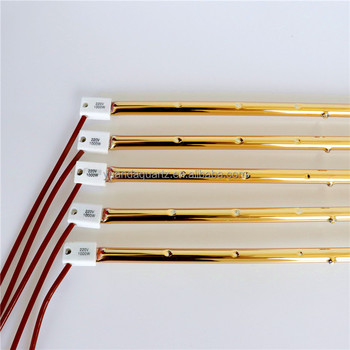
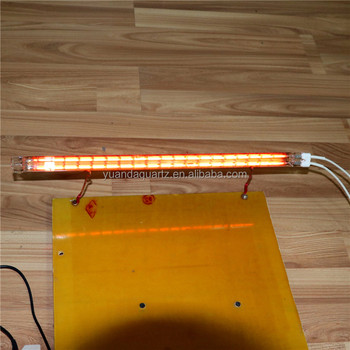
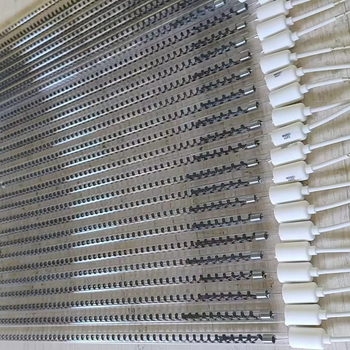
Gold-Coated Short-Wave IR Lamp
Features a 24-carat pure gold reflective film directly fused to the rear quartz wall. Reflects over 95% of rear infrared radiation toward the car panel, doubling forward irradiance while keeping cassette backs cool.
Constructed with an engineered 23×11mm or 33×15mm double-channel fused quartz profile. Offers unmatched mechanical rigidity against sagging across long lengths (up to 3,000mm) with dual independent circuits.
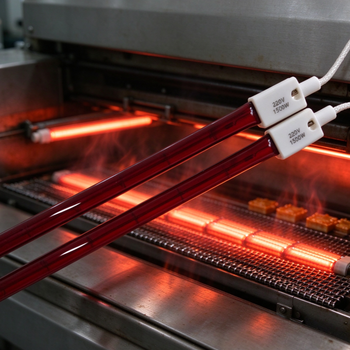
Formulated with red-tinted quartz glass containing rare-earth oxides to filter out intense visible glare (reducing visible luminescence by over 80%) while maintaining full short-wave infrared thermal transmission for bodyshop safety.
Utilizes woven carbon filament ribbons that emit precisely tuned medium-wave energy. Outstanding efficiency for accelerated water evaporation during modern OEM waterborne automotive basecoat applications.
Note: Every curing system requires specific consideration of filament tension, spring-loaded internal anchors, end cap architecture (ceramic flat caps, leads with ring terminals, fast-lock connectors), and burning position (horizontal vs. universal). Kavri Quartz Product Co., Ltd. provides comprehensive OEM drawing confirmation prior to manufacturing.
Future Procurement Trends in Car Paint Curing
How global purchasing managers, equipment integrators, and distributors are adapting their sourcing strategies for the automotive aftermarket and OEM assembly lines.
1 Transition to Integrated Fast-Cure Waterborne Systems
With environmental volatile organic compound (VOC) mandates tightening across the European Union, North America, and East Asia, solvent-borne basecoats are largely replaced by waterborne formulas. Procurement agents now specify hybrid or staged dual-wavelength arrays: medium-wave carbon fiber lamps are deployed for ultra-fast de-watering flash-offs, followed immediately by short-wave tungsten halogen emitters to cross-link the scratch-resistant 2K clearcoats. Equipment buyers favor suppliers capable of supplying both emitter wavelengths from a single manufacturing source.
2 Energy Cost Containment & Directional Precision
Global energy inflation has rendered running 40kW whole-booth convection baking cycles economically unviable for minor collision repairs and single-panel touch-ups. Procurement is rapidly shifting toward targeted IR arch systems and mobile drying cassettes fitted with gold-coated reflectors. Because gold layers reflect 95% of short-wave IR directly onto the repair zone, power consumption drops by over 60%, driving demand for replacement emitters engineered with permanently bonded, non-flaking vacuum-sputtered gold mirrors.
Bodyshop equipment distributors are standardizing spare parts inventories to reduce stocking SKUs. Instead of sourcing proprietary lamps from individual booth manufacturers at marked-up prices, corporate buyers are directly partnering with dedicated quartz manufacturers like Kavri Quartz Product Co., Ltd. to produce universal OEM replacement emitters with versatile mounting terminals, custom lead wire lengths, and cross-brand voltage compatibility (110V, 220V, 380V, 480V).
4 Long-Life Quartz Envelopes with Higher Silica Purity
Procurement teams are prioritizing certified high-purity quartz silica (SiO2 ≥ 99.99%) over cheaper commercial-grade glass. High-purity fused silica withstands internal envelope operating temperatures above 900 °C without devitrification (crystallization and opacity), ensuring the lamp maintains constant radiant spectrum and does not suffer sudden tube rupture or premature filament burnout during thermal shock cycles.
Engineering advancements transforming modern car paint drying into an automated, digitally monitored, and thermally controlled operation.
The automotive coating industry is experiencing unprecedented material evolution, from ultra-high-solid (UHS) polyurethanes to ceramic nanocoatings and temperature-sensitive substrates (such as lightweight carbon fiber composites, thermoplastic polyolefins, and aluminum alloy panels). To process these sensitive surfaces without warping substrates or blistering paint layers, car paint curing infrared lamp technology is integrating advanced optical and sensor-driven capabilities:
Laser Pyrometer Feedback
Closed-Loop Temperature Control
Next-generation curing cassettes integrate non-contact infrared optical sensors that continuously measure substrate surface temperature. The data instantly modulates lamp voltage via zero-crossing solid-state relays (SSRs), ramping up to exactly 65 °C for waterborne drying or 130 °C for powder bake, and holding it within ±2 °C tolerance.
Dual-Wave Dynamic Arrays
Segmented Intelligent Zoning
Modern mobile paint dryers now incorporate independent PLC-controlled zone firing. Lamps fire selectively based on panel geometry sensors, directing radiant energy exclusively to the repair patch. Unused cassette zones shut down automatically, eliminating wasted peripheral kilowatt-hours.
Sub-Micron Vacuum Deposition
Resistant Nano-Gold Coatings
Traditional liquid-dip gold coatings tend to oxidize and peel under aggressive spray-booth solvent mists and high thermal cycling. Kavri Quartz utilizes state-of-the-art vacuum magnetron sputtering to deposit micro-thin gold layers that resist delamination up to 800 °C quartz wall temperatures.
Car Paint Curing Lamp Procurement FAQ
Detailed technical answers addressing common engineering queries, replacement specifications, and operational challenges submitted by international buyers.
What is the critical difference between short-wave and medium-wave IR for automotive coatings?
Short-wave infrared (SWIR, 0.9–1.4 μm) has high photon energy and deep penetration capacity. It passes directly through clear and pigmented coatings to warm the underlying steel or aluminum body panel, inducing inside-out curing that expels solvents cleanly and cures 2K polyurethanes in 10–15 minutes. Medium-wave infrared (MWIR, 2.0–2.6 μm) is predominantly absorbed directly by water molecules and surface resins, making it exceptionally effective for flash-off stages of waterborne coatings and plastic bumper repairs where substrate overheating must be avoided.
Why is a gold reflector superior to ceramic white or plain external aluminum reflectors?
Gold is an outstanding natural reflector of infrared electromagnetic radiation, achieving over 95% reflection efficiency in the short-wave spectrum. Applying gold directly to the rear half of the quartz tube envelope directs virtually all radiant energy toward the vehicle surface. This eliminates rear thermal loss, keeps the internal reflector cassettes significantly cooler, and delivers approximately 25–35% more radiant heat to the paint than an uncoated lamp with a standard aluminum reflector plate.
Can your car paint curing lamps directly replace European or American brand emitters?
Yes. Kavri Quartz Product Co., Ltd. has over 10 years of OEM/ODM reverse-engineering and fabrication experience. We manufacture drop-in replacements for standard equipment brands (including Trisk, IRT Hedson, Spectratek, Infratech, and custom booth arrays). You only need to share the lamp length (overall and heated length), wattage, voltage (e.g., 230V, 400V), and end cap/terminal type (such as SK15, R7s, flat ceramic, or insulated leads with eyelet terminals).
How do you prevent filament sagging in horizontal or angled curing cassettes?
At operating temperatures of 2,000 °C, standard tungsten coils expand and can sag under gravity, potentially contacting the quartz wall and causing localized devitrification or tube blowout. We utilize tungsten wire with specialized non-sag crystal dopants, supported internally by precision-spaced molybdenum or tungsten spiral support rings along the entire heated length. This allows reliable operation whether the lamp is oriented horizontally, vertically, or at an angle on an overhead arch.
What is the typical operating lifetime of your car paint curing lamps, and what causes failure?
Our short-wave halogen car paint curing lamps are rated for 5,000+ continuous operating hours. The primary causes of premature failure in bodyshops are finger grease contamination on the quartz glass (salts in skin oils cause localized devitrification when heated), mechanical vibration while the filament is white-hot, and inadequate cassette air ventilation causing pinch-seal temperatures to exceed 350 °C (which oxidizes the molybdenum pinch foil). We engineer robust hermetic pinch seals to maximize field reliability.
What is your Minimum Order Quantity (MOQ) and production lead time for custom OEM batches?
For standard replacement specifications, our MOQ starts from 8 to 10 pieces to support distributor trial orders. For completely custom tube geometries or OEM-branded production runs, MOQs typically range from 20 to 50 pieces. Prototype samples are completed in 5 to 7 working days, while bulk batch orders of 500 to 2,000 units are fulfilled within 15 to 20 working days.
How do you package fragile quartz emitters to guarantee zero breakage during sea and air transit?
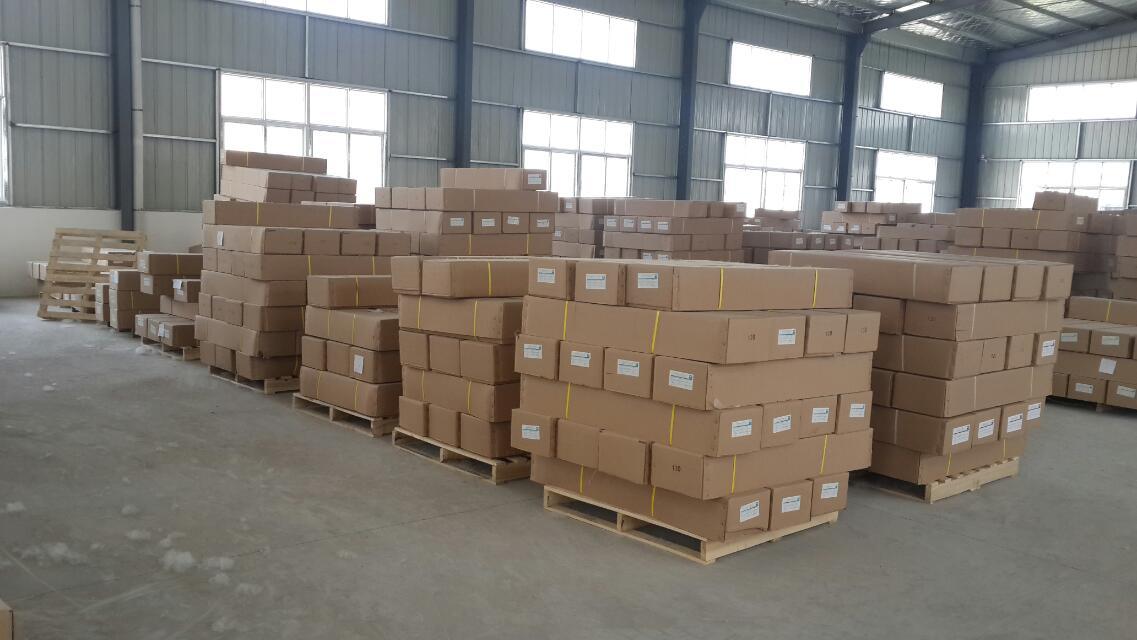
Every lamp is individually encased in a heavy-duty cylindrical cardboard tube or custom pearl cotton (EPE) slotted mold. Individual tubes are packed into reinforced inner cartons, which are then packed into 5-ply corrugated export master boxes reinforced with multi-layer bubble cushioning. For international sea freight or LCL shipments, master cartons are palletized and stretch-wrapped or placed into fumigated plywood export crates.
Enterprise Advantage
Manufactured by Kavri Quartz Product Co., Ltd.
Kavri Quartz Product Co., Ltd. is a highly professional and experienced manufacturer and exporter of infrared heat lamps, halogen lamps, and high-purity fused quartz glass products in China. Our modern production complex is situated in Donghai Town, Lianyungang City, Jiangsu Province — globally celebrated as China's premier silica and quartz processing capital.
Operating directly at the heart of this regional materials cluster grants us distinct raw material advantages: direct access to optical-grade fused silica crystal, localized glass blowing craftsmanship, and complete supply integration for gas purifiers, vacuum sputtering, and tungsten filament processing. With over 10 years of focused OEM/ODM development and 13 continuous years of verified supplier standing on Alibaba.com, our car paint curing lamps, halogen heaters, and quartz elements are exported to established brands across Germany, the Netherlands, Japan, South Korea, the USA, and worldwide.
Send us your required lamp drawing, old emitter sample photos, or electrical specifications (wattage, voltage, length, reflector). Our optical engineering team provides technical feedback and factory-direct pricing within 4 hours.