Choosing the best Fused Quartz type for 2026 depends less on a single “top” grade and more on the job it must perform. A clear tube near a furnace, a precision lens, and a semiconductor process component face different demands. UV transmission, thermal shock resistance, bubble content, dimensional tolerance, and acceptable impurity levels can each change the decision. There is no universal winner.
This guide compares common manufacturing routes and material grades, including electrically fused and flame-fused options, while explaining where optical-grade fused silica may be specified instead. The terms can overlap in supplier catalogs, so buyers should check composition, test methods, and the exact product datasheet. Small differences matter. A visible bubble, for example, may be irrelevant in one sight glass but unacceptable in a sensitive optical path. Temperature limits also depend on geometry, exposure time, and thermal cycling—not just a headline service-temperature figure.
For a reliable comparison, we will look at application fit, consistency, processing, and total cost rather than price alone. Ask suppliers for traceable specifications and confirm that reported properties match your operating conditions. If available, review sample inspection records before committing to a production order. The right choice may be less obvious than expected. Some specifications are difficult to compare across vendors, and a datasheet cannot replace testing in the actual assembly. That is worth admitting. The sections ahead offer a practical framework for narrowing the options, identifying trade-offs, and choosing Fused Quartz with evidence instead of guesswork.
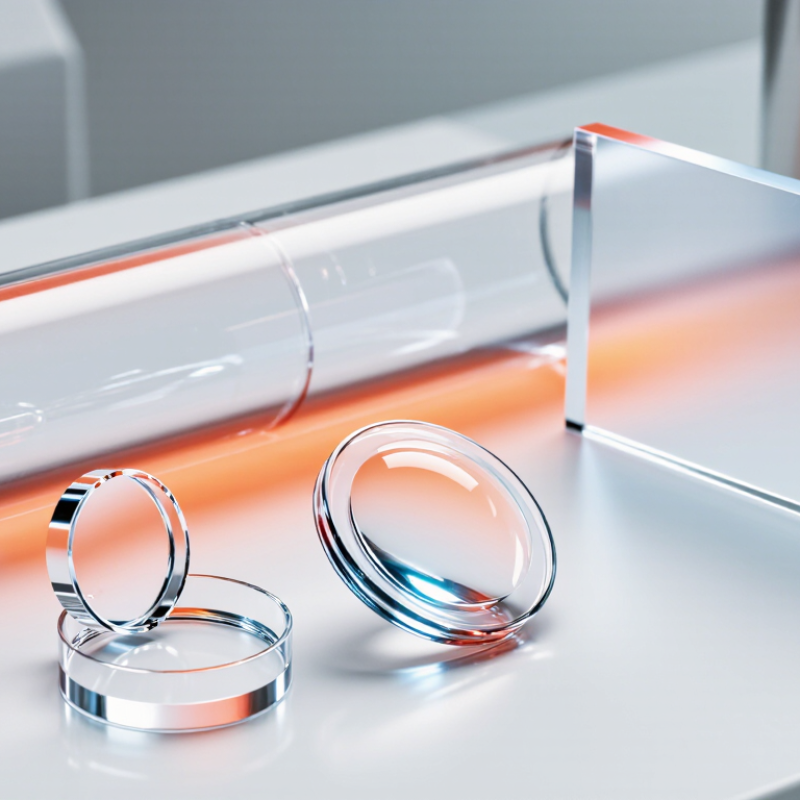
Understanding Fused Quartz and Its Main Types
Fused quartz is made by melting high-purity silica, but feedstock and manufacturing route change its performance. ASTM C162 provides terminology for glass and related materials; engineers also compare transmission, bubbles, hydroxyl content, and thermal behavior. The main categories are electrically fused, flame-fused, and synthetic fused silica. Names can vary between suppliers, so check the stated process and grade.
Electrically fused quartz is commonly made from natural quartz and suits many furnace tubes, crucibles, and sight glasses. Flame-fused material is formed with a hydrogen-oxygen flame and can be shaped into complex parts, though fabrication skill affects consistency. Synthetic fused silica uses chemical feedstock, often offering very high purity and strong ultraviolet transmission. NIST reference data place fused silica’s room-temperature thermal expansion near 0.5 × 10⁻⁶ per kelvin. That is exceptionally low. It helps reduce stress when temperatures shift, but does not make every component immune to thermal shock.
For selection, match the type to the actual wavelength, temperature cycle, and contamination limits. A lamp envelope may prioritize ultraviolet transmission; a furnace fixture may need resistance to repeated heating. Ask for measured data on transmission, bubbles, and hydroxyl content, not just a “high purity” label. In practice, the neat categories can blur. Processing history matters, and a cheaper grade may perform well in one application but disappoint in another.
Comparing Key Properties of Different Fused Quartz Types
Which Fused Quartz Type Is Best for 2026?
Fused quartz types differ most in purity, hydroxyl content, bubble level, and optical transmission. Natural fused quartz suits many furnace tubes and sight windows, where thermal stability matters more than deep-UV clarity. Synthetic fused silica typically offers better ultraviolet transmission and tighter impurity control, making it useful for UV optics and demanding process equipment. Malitson’s benchmark dispersion measurements, published in the Journal of the Optical Society of America in 1965, place fused silica’s refractive index near 1.458 at 589 nanometers. A useful reference, but not a complete grade specification.
Thermal shock resistance is another key comparison. Industry technical data commonly place fused silica’s room-temperature expansion coefficient near 0.5 parts per million per kelvin. That low value helps parts tolerate rapid heating, though geometry and surface flaws still matter. Opaque fused quartz, with light-scattering bubbles, can be preferable for some radiant-heating applications. It is not a cheaper substitute for optical grades; its purpose differs.
For selection, compare the actual operating wavelength, maximum temperature, and impurity limits on a lot-specific certificate. Semiconductor applications often prioritize trace metals and dimensional consistency, while laboratory windows may prioritize transmission and low birefringence. Ask for measured data, not just a grade label. Labels can be vague. Even a high-purity grade may disappoint if its wavelength range or bubble specification misses the application.
Which Fused Quartz Type Is Best for 2026? - Comparing Key Properties of Different Fused Quartz Types
“Best” depends on the application: UV performance, impurity limits, optical uniformity, and cost can matter more than the manufacturing route alone. The categories below are not always mutually exclusive—for example, flame fusion describes a process, while synthetic describes the feedstock.
| Type |
Feedstock or Production Route |
Typical Characteristics |
UV and Optical Considerations |
Common Applications |
Main Trade-Off |
| Natural-feedstock electrically fused quartz |
High-purity natural quartz is melted using electrical heating. |
Available in clear grades; trace-element content and homogeneity depend on raw material selection and refining. |
Transmission depends on impurities, hydroxyl content, and grade. Check the supplier’s spectral-transmission data for the intended wavelength. |
General-purpose laboratory ware, sight windows, and high-temperature components. |
Often a practical general-purpose choice, but not automatically suitable for the strictest UV or semiconductor purity requirements. |
| Flame-fused silica |
Silica feedstock is melted in a flame; the feedstock may be natural or synthetic. |
Can be formed into rods and other shapes. Hydroxyl content and bubbles depend on the feedstock and process conditions. |
Optical quality is grade-specific. Verify transmission, bubbles, and striae requirements rather than relying on the process name alone. |
Quartz rods, lamp components, and selected optical or laboratory parts. |
A useful forming route, but “flame-fused” alone does not guarantee a particular purity or UV-transmission level. |
| Synthetic fused silica |
Produced from chemical precursors, commonly through flame hydrolysis or related vapor-deposition processes. |
Can achieve very high chemical purity; hydroxyl content can vary substantially by production method and grade. |
Often selected for demanding UV optics, but the usable wavelength range must be confirmed from grade-specific data. |
UV optics, photolithography components, and applications with demanding contamination limits. |
Typically offers tighter control of purity, but may cost more and still requires specification checks for OH content and optical homogeneity. |
| Opaque fused quartz |
Fused silica containing distributed bubbles that scatter light; it may be made using different melting routes. |
Diffuses or blocks visible light and generally provides better thermal insulation than clear fused silica. |
Not intended where clear transmission or image quality is required. |
Furnace insulation, heater supports, and other high-temperature thermal components. |
Useful when insulation is the priority; unsuitable for transparent optical parts. |
Shared thermal baseline: Fused silica has a very low coefficient of thermal expansion, approximately 0.5–0.6 × 10⁻⁶ K−1 near room temperature, and a softening point around 1665°C. Actual values and usable service limits vary by grade, geometry, and test conditions.
Matching Fused Quartz Types to Their Applications
Which Fused Quartz Type Is Best for 2026?
Matching fused quartz to an application starts with heat, purity, and optical needs. Electrically fused quartz suits many furnace tubes, crucibles, and lamp envelopes. It handles repeated heating well and offers useful chemical resistance. For a hot tube near a furnace opening, thermal durability may matter more than perfect clarity.
Flame-fused quartz is often chosen for smaller parts, rods, and components that need careful shaping. Its low contamination can help in sensitive processes, though fabrication details still affect performance. Synthetic fused silica is a stronger option when consistent optical transmission and very low impurity levels are critical, such as in precision lenses or UV optics. It can cost more, so the added purity should match a real requirement.
Check the operating temperature, wavelength, dimensions, and exposure to chemicals before selecting a grade. Ask for data on bubbles, hydroxyl content, and optical transmission when those properties affect the part. Small differences matter. A clear window for visible light may not perform as expected under ultraviolet exposure. There is no perfect universal pick; I would not choose by type name alone. Specifications can vary, and an application test may reveal a weakness that a datasheet does not.
Choosing the Best Fused Quartz Type for Specific Needs
Choosing the Best Fused Quartz Type for Specific Needs
The right fused quartz depends on what the part must do, not just its price or appearance. Clear material is often selected for optical windows, lamps, and components that need strong ultraviolet transmission. Check the required wavelength range: transmission can vary with purity, hydroxyl content, and manufacturing method. Small details matter.
For high-temperature parts, ask for data on thermal expansion, operating temperature, and resistance to thermal shock. A tube near a furnace may face rapid heating, while a sight window may also need low bubble content and consistent clarity. Electrically fused material can suit many general industrial uses. More demanding optical or semiconductor applications may call for tighter limits on trace metals and internal defects. Request test data for the actual grade, rather than relying on a broad “high purity” label.
Form matters, too. Thin plates, narrow tubing, and complex shapes can have different production limits and costs. Flame-fused parts may work well for small, shaped components, but availability and dimensions should be confirmed with the fabricator. There is no universal winner, which is mildly inconvenient. I would compare the operating conditions, inspection requirements, and acceptable lead time before choosing a grade. One overlooked factor is cleaning: surface contamination can undermine an otherwise suitable part.
Which Fused Quartz Type Is Best for 2026?
Compare representative coefficients of thermal expansion (CTE). Lower CTE generally means less dimensional change during temperature shifts.
How to choose: Synthetic fused silica is often preferred for demanding optical and ultraviolet applications, while electrically fused and flame-fused quartz are widely used for general high-temperature components. Their typical CTE values are very similar; purity, optical transmission, dimensions, and fabrication method may matter more than this comparison. Values are approximate, and actual specifications vary by grade and supplier.
Conclusion
Choosing the best Fused Quartz type for 2026 requires more than selecting the highest purity grade. Fused Quartz is available in several forms, each offering a different balance of optical clarity, thermal resistance, chemical stability, dimensional reliability, and manufacturing cost. Some types are ideal for ultraviolet and visible-light transmission, while others are better suited to high-temperature processing, laboratory equipment, semiconductor environments, or demanding industrial components. Understanding these differences helps users avoid paying for properties they do not need or selecting a material that cannot withstand actual operating conditions.
The right choice should be based on application requirements, including temperature range, exposure to chemicals, light transmission, contamination limits, mechanical stress, and expected service life. In 2026, buyers will likely place greater emphasis on consistent purity, energy-efficient production, reliable performance, and total cost over time. By comparing material properties alongside budget and technical demands, organizations can select a Fused Quartz type that delivers the most practical combination of performance, durability, and value for their specific needs.